 Have you spent time building an audience?
Posting. Engaging. Hashtag researching. Creating content calendars. Analyzing metrics. Reading books about building your personal brand. Taking courses on growing your following.
The “build an audience first” advice that dominates online business circles works great for people who already have audiences. For the rest of us? It’s a slow, demoralizing grind that leads nowhere.
Here’s what I wish someone had told me when I started: there are side hustles that don’t require a single follower to generate income. Real income. The kind that shows up in your bank account regardless of whether anyone knows your name.
I’m going to tell you about one of them. But first, let me explain why everything you’ve been told about side hustles is probably backwards.
The Audience Trap Nobody Talks About
Every side hustle guide says the same thing: build an audience, create content, monetize later.
 There’s just one problem. According to Bankrate research, the median monthly income for side hustlers is $200. Not the average; the median. That means half of the people with side hustles earn less than $200 a month. And a significant portion, specifically 28%, are making between $1 and $50 monthly.
Meanwhile, the “build an audience” advice continues to flow.
Look, I get why this approach is so popular. It makes for great content. It sounds strategic. And for people selling courses on audience building, it’s pretty convenient advice.
But here’s what the gurus don’t mention: building an audience from scratch, with no existing platform or connections, typically takes years. During those years, you’re working for free, hoping that someday the followers will translate into revenue.
For most people, they don’t.
The people who make this work often had an advantage going in. They had industry connections. They were early to the platform. They had money to invest in ads or outsourcing. Something gave them a head start that they conveniently omit from their success stories.
So what’s the alternative?
Why “Product First” Beats “Audience First”
Instead of building an audience and then figuring out what to sell them, what if you created something people are already searching for and buying?
This sounds obvious when you say it out loud. But it runs completely counter to the dominant advice in online business spaces.
 The product-first approach works because of one simple fact: some markets have built-in demand. People actively search for and purchase certain products regardless of who made them.
The print-on-demand market is one such space. According to industry research, the global print-on-demand market was valued at around $10 billion in 2024 and is projected to grow at roughly 25% annually over the next decade. That’s not a small niche; that’s a massive market with room for new sellers.
Within POD, there’s a category that doesn’t get nearly as much attention as t-shirts: wall art.
The global wall art market was valued at over $60 billion in 2024 and is growing steadily. Fortune Business Insights projects it will nearly double by 2032. Residential buyers account for over 70% of purchases, and demand for affordable, unique pieces continues to rise.
People need stuff to put on their walls. Homeowners, renters, offices, restaurants. They’re searching for it right now. And they don’t particularly care whether the creator has 10,000 Instagram followers or 10.
The Math That Actually Works
Let me break down why this is different from the typical side hustle grind.
When you’re building an audience, here’s your equation:
 Create free content → Hope people see it → Hope they follow → Hope they stay engaged → Eventually try to sell something → Hope they buy
That’s a lot of hoping. And each step has a significant drop-off rate.
When you’re selling products in a marketplace with existing demand, the equation looks different:
Create product → List in marketplace where buyers already shop → Buyer searches for what you made → They purchase
The buyer doesn’t need to know you exist beforehand. They’re not following you. They’re searching for “abstract wall art for living room,” or “minimalist ocean print,” or whatever matches their interior. If your product shows up and looks good, they buy.
This is why Podbase’s 24% three-year survival rate for print-on-demand businesses is reasonable relative to the overall online business survival rate. When 90% of online businesses reportedly fail within the first 120 days, a nearly 1-in-4 survival rate after three years starts looking pretty solid.
But Wait, I Can’t Create Art
Here’s where it gets interesting.
You don’t need to be an artist. Not anymore.
 have completely changed what’s possible for people without traditional art skills. You can describe what you want; maybe a serene forest scene at sunset, or an abstract geometric pattern in teal and gold, and get a unique image in seconds.
I know what you might be thinking. Isn’t AI art low quality? Won’t everything look the same?
Honestly? A year ago, those concerns made sense. Today, not so much. The tools have gotten dramatically better. And more importantly, the skill isn’t in the AI itself; it’s in knowing what to create and how to describe it.
Someone who understands what buyers want, which colors pair well, which styles are trending, and how to write effective prompts will produce better work than someone with all the artistic talent in the world but no market awareness.
This is learnable. It doesn’t require an art degree. And it certainly doesn’t require years of building an audience first.
What About Time?
According to various surveys, the largest share of side hustlers spend 5-10 hours per week on their side gigs. That’s manageable for most people with full-time jobs.
 With AI-assisted wall art, you can realistically:
Research trending styles (an hour or two per week)
Generate and refine designs (a few hours)
Create listings with good descriptions (an hour per design)
After the initial learning curve, many people find they can create several new pieces per week in just a few hours of focused work. Not 20 hours. Not every evening and weekend. A few hours.
Compare that to content creation for audience building, where you’re typically posting daily across multiple platforms, responding to comments, engaging with other accounts, and spending hours per day on activities that may never directly generate income.
The Objections (and Why They Don’t Hold Up)
Let me address some points you may be considering.
“The market is probably saturated.”
 In t-shirts? Yes, brutally so. But wall art through print-on-demand is still relatively underexplored. Market research indicates home décor is the fastest-growing POD segment, with projected annual growth of 27–28% through 2030. Apparel has the most competition precisely because that’s where everyone goes first.
“I’d need expensive tools.”
Many AI image generators have free tiers or very affordable subscriptions. You don’t need professional design software. You don’t need to buy inventory. The print-on-demand model means you pay production costs only when an order is placed.
“I’m not tech-savvy.”
If you can type a description of what you want, you can use AI image tools. The interfaces are designed for regular people, not programmers. If you can write an email, you can create prompts.
“It sounds too easy. What’s the catch?”
The catch is that it’s not passive income from day one. You have to learn what sells. You have to create enough listings to give yourself a real chance. You have to be willing to experiment and adjust. But the barrier to entry is dramatically lower than most side hustles, and you’re selling into existing demand rather than trying to create it from scratch.
What Getting Started Actually Looks Like
If you’ve read this far, you’re probably curious about the practical steps. Here’s the honest version, not the oversimplified guru version.
 Month one: You’re learning. Figuring out AI tools. Understanding what sells in the wall art market. Making some designs that probably won’t be your best work. This is normal.
Months two through three: You’re getting better. Your prompts are more effective. You understand design trends. You’re creating listings more efficiently. You might make your first sales. You might not yet.
Month four onward: If you’ve stuck with it, you likely have a growing catalog. Some pieces sell better than others (you’ll learn from this). The work becomes more about optimization and scaling than about figuring out the basics.
This is not “quit your job next month” territory. But it’s also not “spend two years building an audience before making a dollar” territory either. It’s somewhere in between: real work that can produce real results in a reasonable timeframe.
The 36% Who Get It Right
According to Bankrate’s research, about 36% of Americans currently have a side hustle. But within that group, there’s a huge range of outcomes.
The people who do well tend to have a few things in common. They chose an option with existing market demand rather than trying to create demand from nothing. They started small and scaled what worked. They didn’t try to do everything at once.
They also, importantly, didn’t wait until conditions were perfect. They didn’t wait until they had 10,000 followers, the perfect website, or complete expertise in every aspect of online business.
They just started.
What I’d Do Differently
If I could go back to when I started my side hustle journey, here’s what I’d tell myself:
Stop trying to build an audience before you have something to sell. The audience-first approach makes sense for people who want to become influencers or coaches. For most people who just want extra income, it’s the long way around.
Pick a market where people are already buying. Wall art is one option. There are others. But the key is existing demand, not demand you have to create.
Use tools that lower the barrier to entry. AI has made it possible to create professional-looking products without professional skills. Take advantage of that.
Expect it to take a few months before things click. Anyone promising overnight results is probably selling something. Real side hustles take time to build. But a few months is very different from a few years.
Your Next Step
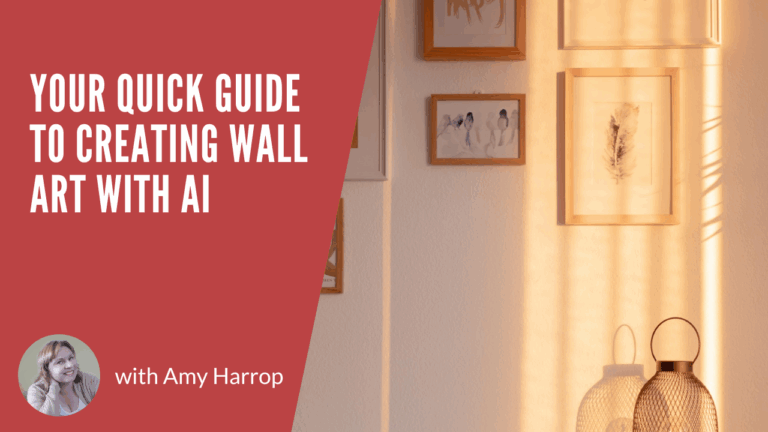
If this approach resonates with you, I’d recommend checking out my free blog post, Your Quick Guide to Creating Wall Art with AI. It walks through the process, from brainstorming to drafting prompts to saving files in the correct print-on-demand format.
It’s not a course. It’s not a program. Just a straightforward walkthrough of how to get started.
Because here’s the thing: you can keep scrolling. You can bookmark this article and think about it later. You can add “research wall art side hustle” to your list later.
Or you can actually look into it. Today. See if it makes sense for you.
The people who build successful side hustles aren’t fundamentally different from the people who don’t. They just start. And then they keep going.
Whether it’s wall art or something else entirely, I hope you find what works for you. The thing that doesn’t require years of audience building, 20 hours a week, or tools you can’t afford.
It exists. I promise.
If you found this useful, I write about practical income strategies for people who are tired of the typical hustle culture advice. No guru energy. No “just work harder” nonsense. Just real approaches that work for real people with real constraints.