 You’ve been told you need to “find your niche.”
So you started researching. Reading blog posts. Watching YouTube videos. Making lists. Second-guessing those lists. Starting over. Reading more blog posts.
And somehow, three months later, you still haven’t actually launched anything.
You’re not lazy. You’re not dumb. You’re stuck in something that feels productive but actually isn’t: analysis paralysis.
I’ve been there. So has pretty much every creator I know. The good news? There’s a faster way.
The Niche Research Trap
 Here’s what typically happens when someone decides to start selling digital products, publishing books, or building any kind of content-based business:
They hear “pick a profitable niche” and interpret that as “spend endless hours finding the perfect niche before doing anything else.”
So they research. And research. And research some more.
They find a promising niche, then read one negative thing about it and start over. They compare 47 different options in a spreadsheet that keeps growing. They join Facebook groups asking, “Is X niche too saturated?” and get 50 conflicting opinions.
Months pass. Nothing gets created. Nothing gets launched.
The irony? All that research doesn’t even guarantee they’ll pick a winner. Because traditional niche research is kind of broken.
Why Traditional Niche Research Takes Forever (and Often Fails Anyway)
The old way of finding a profitable niche looked something like this:

- Browse marketplaces manually, looking for gaps
- Use keyword tools (most of which require paid subscriptions and learning curves)
- Study competitor listings one by one
- Try to spot patterns in what’s selling
- Make educated guesses about what might work
- Hope you’re right
This process is time-consuming, requires skills most beginners don’t have, and still leaves you guessing.
According to research from OrbitMedia, only 41% of bloggers include original research when creating content. The rest are essentially winging it based on assumptions and whatever they’ve heard works.
And the stakes are real. Studies on startup failure consistently show that somewhere between 34% and 42% of new ventures fail specifically because there’s no market need for what they’re building. Not because the product was bad. Because nobody wanted it in the first place.
When your niche selection is based on surface-level research and gut feelings, you’re gambling. And the house usually wins.
The Real Goal (It’s Simpler Than You Think)
Let’s strip this back to basics.
 What you actually need to know before picking a niche:
- Are people actively searching for solutions in this space? (Demand exists)
- Is there room to offer something better or different than what’s already out there? (Opportunity exists)
- Can you realistically create content or products in this space? (You can actually execute)
That’s it. You don’t need to find the “perfect” niche. You need to identify a viable niche with real demand and a gap you can fill.
Perfection is the enemy of launching. And launching is the only way you actually learn what works.
What If Research Took 30 Minutes Instead of 3 Months?
I want you to imagine something.
Instead of spending weeks piecing together information from different sources, you could ask a simple question and get back a detailed report that tells you:

- What problems are people in a niche actively trying to solve
- What’s trending right now (before everyone else catches on)
- What’s missing from current offerings
- What content or products are actually selling
- What search terms are people using
All in one place. All in minutes.
This isn’t hypothetical anymore. AI tools have gotten good enough that this is actually possible.
Most people use ChatGPT or similar tools to write content. That’s fine, but it’s honestly the least interesting use. The real power is in research.
The “Deep Research” Feature Most People Don’t Know About
 There’s a specific AI tool capability that differs from standard chat. It’s called “deep research” (or a similar term, depending on the platform).
Instead of giving you quick, surface-level answers, it actually digs into data sources, synthesizes information, and produces comprehensive analysis.
Think of regular AI chat like asking a friend who’s kind of familiar with a topic. Deep research is like asking a professional analyst with access to far more information than you do, and who can process it faster.
And here’s the thing: this feature is available in ChatGPT, Gemini, Claude, and Perplexity. Some even offer it at the free level.
The catch? Most people don’t know how to use it properly. They ask vague questions and get vague answers. Or they don’t realize the feature exists.
What Smart Niche Research Actually Looks Like Now
 Let me walk you through what’s possible when you use AI research correctly.
Scenario: You’re interested in the wellness space but unsure which specific angle to pursue.
Old approach: Spend days browsing Etsy, Amazon, and Pinterest. Look at bestseller lists. Read blog posts about “profitable wellness niches.” Make a giant list. Get overwhelmed. Decide “wellness is too saturated.” Start over with a different broad topic.
New approach: Use AI deep research to answer specific questions like:
- “What problems are people searching for help with in the wellness space that have high search volume but limited quality solutions?”
- “What wellness sub-niches are trending upward in the past 6 months?”
- “What are the most common complaints about existing wellness journals/planners/guides?”
Within minutes, you have actionable data.
You can see that “stress management for new managers” is underserved. Or that “sleep journals for shift workers” has a growing demand but limited options. Or that people are frustrated with wellness products that are too generic and not tailored to specific life situations.
Now you have somewhere to start. An actual direction based on real demand, not just a hunch.
The Difference Between “Having an Idea” and “Validating Demand”
I want to be clear about something: having a niche idea is not the same as knowing people will pay for products in that niche.
Ideas are easy. Validation is what matters.
 Before AI tools existed, validation meant:
- Creating a product and seeing if it sells (expensive and time-consuming)
- Running ads to test interest (requires budget and skills)
- Manually analyzing competitors and reviews (tedious)
- Surveying potential customers (hard to find them before you have an audience)
Now, you can get a pretty solid read on demand before you create anything. Not a guarantee, obviously. Nothing in business is guaranteed. But you can stack the odds much more in your favor.
The creators who consistently succeed aren’t necessarily more talented. They’re better at understanding what people want before they invest their time and energy.
“But I Don’t Have Time to Learn New Tools”
I hear this a lot, so let me address it directly.
You don’t need to become an AI expert. You don’t need to spend hours learning prompting. You just need a system that tells you exactly what to ask and how to use the results.
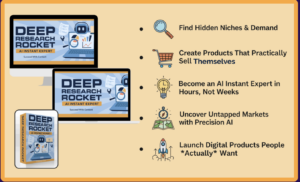
 My tool and training: Deep Research Rocket. It’s built around this exact problem.
I’ve put together the specific prompts, workflows, and step-by-step training for using AI deep research to find profitable niches and validate demand. It works with ChatGPT, Gemini, Claude, Perplexity, and even free accounts.
It includes a custom GPT that handles most of the heavy lifting. Upload your research results to help you structure content or products around what you found.
I’m not saying you can’t figure this out on your own. You probably can. But if you’ve already spent months stuck in analysis paralysis, having a done-for-you system might be worth more than your time trying to piece it together.
A Simple Framework to Get Unstuck
If you’re currently drowning in indecision, here’s a practical way forward:
Step 1: Pick a broad area you’re at least somewhat interested in. It doesn’t have to be a passion. Just something you can stand to work on.
Step 2: Use AI deep research to find sub-niches with real demand. Look for problems people are actively trying to solve. Look for gaps in existing solutions.
Step 3: Pick one sub-niche and commit to it for 90 days. Not forever. Just long enough to actually test it.
Step 4: Create something and put it out there. It won’t be perfect. That’s fine. You learn more from launching than from researching.
Step 5: Pay attention to what happens. What gets traction? What doesn’t? What questions do people ask? Adjust based on real feedback, not hypothetical concerns.
This framework isn’t fancy. But it works. And it works a lot faster than endless research cycles.
The Bottom Line
 Finding a profitable niche doesn’t have to take 6 months.
The old way (manual research, guesswork, endless deliberation) is slow, frustrating, and often leads nowhere.
The new approach uses AI-driven research to compress weeks of analysis into minutes. You get actual data on what people want, what’s trending, and where the gaps are.
Is it perfect? No. Nothing replaces actually putting something out there and seeing how the market responds. But it dramatically improves your odds and gets you to the starting line faster.
If you’ve been stuck in research mode for too long, it may be time to try a different approach. Do the smart research. Make a decision. Start creating.
Your perfect niche won’t reveal itself through more deliberation. It’ll reveal itself through action informed by good data.
Deep Research Rocket is one way to get that data faster. But whatever approach you use, the principle is the same: stop guessing, start knowing, and get moving.
You’ve researched enough. Now go make something.