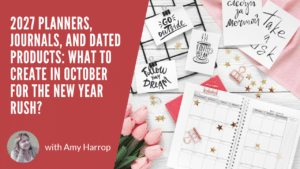
 Most seasonal products get one selling window. Dated products get two.
A 2027 planner listed this month sells in November and December as a gift (“gifts for her,” “gift for the organized friend,” “stocking stuffer”). Then, on December 26, buyer intent flips overnight to fresh starts, and the same listing sells again to the person buying it for themselves. Same file, two seasons, with the second running well into January.
The catch is the same as every other Q4 product: it has to exist early. eRank’s Etsy keyword data had “2026 calendar” already ranking in October last year and flagged it as one of November’s highest purchase-intent searches. Printify’s roundup of Etsy’s marketplace insights lists “2026 planner printable” among the top searches of this year’s first quarter. Buyers are looking for dated products across four months, and the listings that catch all four are the ones with ranking history before the first wave hits.
The holiday product timeline covers the gift side of Q4 in detail, and this month’s Christmas printables guide covers the holiday shelf. This post is about the third leg: what to make now for the new-year buyer.
What “Dated” Actually Means (and Why It’s an Advantage)
A dated product has the year on it: a 2027 weekly planner, a 2027 wall calendar, a dated budget binder. Sellers avoid them because they expire. That’s backwards. The expiration is the reason they sell: a buyer who owns an undated planner never needs another one, but a buyer who owns a 2026 planner needs a 2027 one, and searches for it by year. Dated products create repeat customers on a schedule.
The trade-off is that you rebuild them every fall. Keep that in mind when you design: build the 2027 version from a template you can re-date in an hour next September.
The 2027 Checklist
Here’s what to have listed by mid-November, roughly in order of how reliably they sell:
 2027 planners with a niche. The generic planner market is crowded to the point of uselessness for a new listing. The niche planner market isn’t. A 2027 homeschool planner, a 2027 small-business or Etsy seller planner, a 2027 nurse shift planner, a 2027 wedding countdown planner, and a 2027 content creator planner. Three or four specialty pages inside an otherwise standard layout are what make the niche real.
2027 calendars. Wall calendars in a specific style (the same “pick one strong aesthetic” rule as gift tags), desk calendars, and single-page year-at-a-glance sheets. “2026 calendar” was one of the highest-intent Etsy searches last November; the 2027 version will be too.
Dated budget and finance printables. A 2027 budget planner, a paycheck-by-paycheck budget for 2027, a debt payoff or savings tracker with 2027 dates. Money resets are a perennial top New Year’s resolution, and these buyers show up December 26 through mid-January.
Habit and goal products. Habit trackers, “word of the year” worksheets, a 2027 goals workbook, quarterly review pages, and a 2027 vision board kit. Mostly undated, but they sell on the new-year calendar, so list them with the dated products and tag them the same way.
Year-in-review and reflection printables. A “2026 in review” set: best moments, lessons, a letter to next year. These sell in the last two weeks of December to people who aren’t ready for a planner yet but want a ritual.
Niche journals. This is the sleeper category. A gratitude journal, a prayer or devotional journal, a reading log, a travel journal, a garden journal, a self-care journal. They’re bought as gifts in December (a journal is the classic “I didn’t know what to get you, but this is thoughtful” present) and as resolutions in January. They don’t need a year on them, so one listing can run for years, and the interior is mostly prompts, which is fast to produce.
Title It for Both Buyers
For November: the gift buyer. “2027 Planner for Nurses, Printable Weekly Shift Planner, Gift for Nurse.” Tags: “gift for her,” “stocking stuffer,” “nurse gift,” “Christmas gift.”
For December 26 onward: the self-buyer. Update the first line of the description and swap two or three tags toward “new year planner,” “2027 goals,” “fresh start,” and “habit tracker.” Keep the year in the title all the way through.
The gift language goes in during the last week of October, alongside the rest of your holiday listings, and the new-year language goes in the week of Christmas. That’s two ten-minute edits per listing across the whole season.
The KDP Version
Everything above works as a low-content paperback on Amazon KDP, too: dated planners, dated logbooks, journals with prompts. Amazon’s ranking works the same way in spirit. A new paperback needs time to collect its first sales and reviews, so a 2027 planner published on KDP in October has a real shot at the January rush, and one published in December mostly doesn’t. Publish the KDP version at the same time as the printable, not after.
A Shortcut for the Journal Shelf
 If the journal category is the one you keep meaning to get to, Easy AI Niche Journals is built for it. It focuses on four high-demand, lower-competition journal niches, with a 50-plus-page market research guide on who buys each one, more than 90 done-for-you templates in Canva and PowerPoint (22 to 28 per niche), 100 AI prompts for generating the interior content, and an Amazon KDP publishing guide. It’s the fastest route from “I should sell journals” to a listed shelf of them before the December gift wave.
The October Calendar for Dated Products
- October 20 to 31: list the 2027 planners and calendars, with gift language in titles and tags.
- November 1 to 15: list the budget, habit, and goal products; publish the KDP versions.
- December 1 to 20: list the year-in-review and reflection sets; promote the planners as gifts.
- December 26: swap descriptions and tags toward the new-year buyer.
- January 1 to 15: the second peak. Be findable and responsive; don’t list anything new until it’s over.
Dated products are the closest thing printables have to a subscription: the same buyer, back every fall and every January, searching for the next year’s version. Build 2027 now, and 2028 is a template away.